“Optimists can change the world”
Martin Burkhardt believes supporting new technologies is our best bet for improving overall well-being. The experienced lawyer is active in the deep-tech startup scene in Switzerland and is also one of the investors in Kickfund Ventures Fund I. Here he explains why.
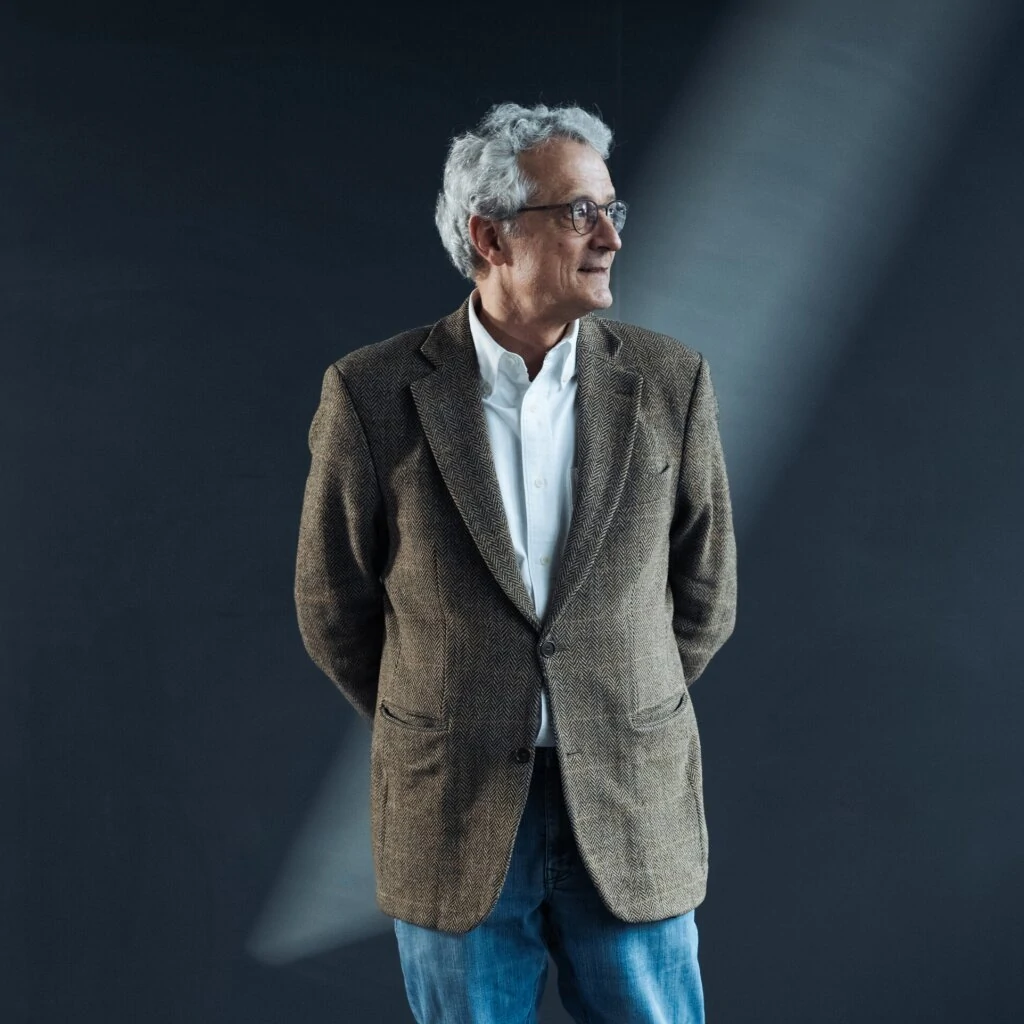
Martin is a litigation lawyer, a charity chair, a private investor, a startup board member, and a science fiction fan – not necessarily in that order. He has worked with the law firm Lenz & Staehelin for over 30 years, and he’s been active in the Swiss deep-tech startup ecosystem for the last 10 of those. Martin was an early investor in Climeworks, and he’s sat on the unicorn’s board since 2012. His newest board post as an investor is at Volumina Medical, a clinical stage med-tech company spun off from the EPFL.
Martin is also a Venture Kick judge, and he played a role in Kickfund’s birth. When asked to join the first fund as an investor, he gladly accepted.
Technology is the great multiplier
A brilliant professor inspired the young Martin to study law at the University of St. Gallen. Law became his trade and career, but he could have taken another path: originally, Martin wanted to start a business. He always carried the desire to create a company, to build an enterprise that spreads great ideas around the world. And now, through his ecosystem engagement, he gets to be part of many such ventures.
The shift came with the death of a long-term client of Martin’s. As was her last will and testament, the Evi Diethelm-Winteler Foundation came to life with the mission to improve human health. The governing board, chaired by Martin, needed a strategy: what was the most impactful way to use the inheritance in service of this mission?
The Evi Diethelm-Winteler Foundation does traditional charity work, such as supporting the Swisscontact ASTHA Project in Bangladesh (High-quality healthcare services in rural areas). Yet the board recognized technological development as the biggest lever: funding new medical technologies was going to be the greatest multiplier for future patient wellbeing. “If we can accelerate the introduction of a novel treatment by even just a year, it can make a real difference for countless patients”, Martin explains. Martin points out that Swiss foundations and tax laws make it possible for traditional foundations to support startups – and that organizations like the Gebert Rüf Foundation and Venture Kick have done exactly that, with remarkable results.
Funding new medical technologies means financing research projects like Zurich Exhalomics by the ETH and the University Hospital Zurich, but it also means backing med-tech startups. This was Martin’s entry into the deep-tech startup world.
Since then, Martin has had the opportunity to support and to invest in many young companies. Soon enough, he found himself in the orbit of the Venture Kick program. Martin was impressed by how much the program and the ecosystem around it had achieved, so he started to contribute there, too. After all this, becoming a Limited Partner at the Venture Kick–spin-off Kickfund was a no-brainer for Martin.
It’s not just altruism; all these engagements are personally gratifying. “Working with outstanding young talent keeps you young”, Martin declares. There are also financial returns, of course. Kickfund, for example, lets Martin spread his investment across a large (and growing!) number of young companies. Calculations suggest a decent return, Martin says.
Founders should pick their investors carefully
Martin continues to invest directly, knowing that picking the right startups is never an exact science. Chance is part of the equation. What matters to him is the groundwork he can do beforehand: following a company’s progress over time and building a strong relationship with its founders before making a commitment. In the end, he says, the startup ecosystem is built on working together. Neither founders nor investors succeed on their own.
Martin’s background as a litigation lawyer is useful when working with companies in tricky situations. An important step in building a company is setting fair rules for all stakeholders. The shareholders’ agreement looks different in the early phase and at a later stage, Martin points out, and so does the optimal mix of shareholders.
One of the most common founder mistakes Martin sees is choosing the wrong shareholders. “You always have a choice of investors, so make sure you pick the right ones for a good balance”, Martin advises. Investors aren’t just piles of money; they are people and organizations you should work with for the benefit of your company.
Martin is fairly hands-off with the companies he backs. Yes, he has a lot of experience, and he is happy to share it with young entrepreneurs. But most of all he encourages founders to go out, speak with people, and then make their own decisions. “As an investor, the only decision I really take is whether I support a company or not.”
People looking to fund deep-tech startups should have a genuine interest in the industry, Martin believes. They need to make the effort to get to know the founders and try to get a grasp on the technologies, the markets and the products. They also need to accept the time it takes to build a deep-tech product: their capital will be blocked at five to ten or more years while the company takes shape. Granted, investing through a vehicle like Kickfund means a faster turnaround, he points out.
Martin describes Switzerland as a traditionally mature economy with well-established companies, while emerging VC-backed technology firms have far less room to operate. Massive capital is less readily available to Swiss startups than in the United States. Even the combined European financial market, in all its fragmentation, pales next to the US.
On the positive side, the smaller scale in Switzerland lets an investor get much closer to the company. The massive financing rounds in the United States leave many backers without any direct feedback or first-hand experience with the product. That is the kind of environment where Theranos-style frauds can happen, Martin muses.
Science fiction coming to life
Watching deep-tech development is like seeing science fiction come to life, Martin says, speaking as a big fan of the literary genre. Many great writers have anticipated the future with surprising accuracy. For example, William Gibson’s Neuromancer trilogy feels very current 40 years after publication, as we witness the rise of artificial intelligence. The Three-Body Problem by Liu Cixin is another striking story about social and political dynamics, disguised as science fiction.
Martin’s foundation work puts him in touch with many med-tech firms, but he is personally also interested in the combination of robotics and AI. Having a machine simulate thinking on a screen is one thing, but putting that mind inside a device that can interact with the physical world is a whole new level. In the context of the Zurich Exhalomics flagship project, Martin was recently impressed by a robot dog that can smell TNT explosives; this tool can discover hidden mines and save human lives, Martin praises.
AI is a polarizing topic, and Martin understands many of the fears. Yet he is wary of stricter constraints for developing machine intelligence. “If you regulate AI until it’s harmless, it’s no longer AI”, he asserts. AI isn’t something we can easily police or stop. Some guardrails are always needed, but the best we can do is develop honest, transparent, and human-friendly machine intelligence, Martin believes.
AI isn’t a unique example, Martin remarks. Our world has always had forces we can't entirely command – many of them our own inventions. Printing was a technology once feared, and so were electricity and steam engines, and still today nuclear energy is highly politicized. Many technologies we cannot fully control, but we have just learned to deal and live with them. However painful the process, we must also learn to live with AI.
Instead of being afraid, Martin believes that the total sum of our toils tends to be positive; fact-driven, transparent, and human-friendly progress is a force for good. He can’t imagine any other way of going about it: if you don’t believe in the possibility of a better tomorrow, how can you make it come true? Optimists really can change the world.